


KitKat may have originated in England but today is one of Japan’s most iconic confectionery brands, having established itself as a local speciality item for both locals and tourists.
According to Nestlé Japan Business Executive Officer (BEO) for Confectionery Olivier Jakubowicz, much of this success has revolved around a deep level of localisation.
“Any global brand that wants to truly become integrated in Japan has to Japanise itself, there is no way around it,” Jakubowicz told the floor at the recent Food and Beverage Innovation Forum (FBIF) in Hangzhou, China.
“This goes far beyond simply having the same product in a different local flavour launched in the market — it requires localisation in terms of innovation, in terms of positioning, in terms of route to market and so much more.”
As a clear case study, Japan is the one market worldwide where ‘Have a break, have a KitKat’ is not the slogan used for marketing as the positioning did not align.
“Instead, we found that every January KitKat sales would spike in Japan during the period of an important university entrance exam. Further analysis saw that KitKat was homophonically similar to ‘Kitto (Surely) Katsu (Win)’ in Japanese, which led to its popularity as a good luck gift for students during this time,” he said.
“Here, there was also a very important local cultural context to note which foreigners would find hard to understand: In Japan, feelings are not directly expressed even between intimate family, yet the love is still there and parents want to express support for their kids but fear pressuring them by wishing ‘good luck’ outright. This is why a gift of encouragement carries a much deeper, heavier meaning in this culture.”
Nestle’s response to this discovery was to fully position KitKat as a tool to express encouragement and hope, facilitating communication between relatives.
Japanising innovation
Beyond its positioning, KitKat has also firmly established itself as a go-to brand for consumers seeking out gift items tagged to a special occasion, or for tourists to bring back home.
This has also stemmed from the brand’s intense focus on centring its innovation on Japanese culture and seasons, which has in turn led to the creation of somewhere between 400 to 500 flavours over the years.
“The core of this is still to have a local purpose and be based on local insights — sure tourists are generally very excited for these flavours, but it has always been important that what we do is still centred on Japan,” Jakubowicz said.
“To this end, we generally leverage three main occasions: the first is Shun culture, which means to respect the moment so we have must a seasonal fruit or flavour at the very start of the season to indicate that hope of rejuvenation. We launch a new flavour every month based on this, such as Strawberry Shortcake.”

The second is Omiyage culture from the ancient Edo era where all travellers, even on just domestic travel from Tokyo to Kyoto, would need to bring souvenirs back home as a sign of bringing back a bit of their travel for those who did not have the chance to go. For this, KitKat created 12 flavours from 12 different regions across Japan ranging from matcha to wasabi to lemon.
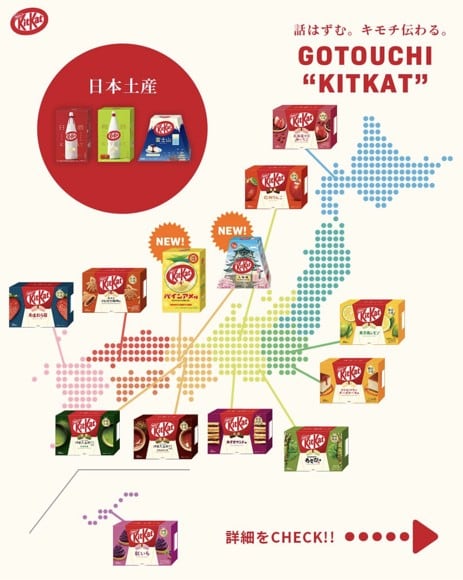

The final important occasion is Valentine’s Day, which may sound like a fairly international celebration but actually carries a different connotation in Japan.
“Valentine’s Day is the biggest season for chocolates in Japan, but it is not just about romantic relationships here. Instead, the season has expanded to cover relationships between adult friends, and this has made products relating to this day even more competitive and premium so we usually create unique high-value products for this season,” he added.
Learnings for other markets
While ‘Japanisation’ is unlikely to be directly transferable to other international markets, Jakubowicz believes there are some confectionery learnings to be had from KitKat’s journey in this market.
“One of the reasons our positioning for encouragement was so successful was due to the immense pressure that students undergo when it comes to the exams in Japan, and this is quite similar in countries such as China and South Korea,” he said.
“It is also important to note that the localisation strategy applies to different degrees in different markets, but it is quite clear that no brand should try to fore feed western flavours of their products to Asian markets.”
KitKat’s success in its seasonal innovations has also driven the rise of ‘seasonal’ shelves in various retail outlets, sections that solely sell the seasonal flavours such as matcha or chestnut as opposed to ‘regular’ KitKat flavours like mint chocolate.

“This is something that can also apply across the board, as it is a strategy that has greatly helped in preventing the cannibalisation of our core portfolio sales,” he added.
“Confectionery is very competitive in markets like China, and no one wants to see cannibalisation within their portfolio, so separating the core products and seasonal ones can not only help to prevent this but separately draw in more types of consumers depending on their needs.”