


Key takeaways:
- Replacing synthetic reds is no longer the biggest hurdle – developing a plant-based alternative that matches carmine’s stability remains one of food science’s toughest formulation challenges.
- Natural colour reformulation affects far more than ingredients, requiring manufacturers to rethink processing, shelf life, packaging and product performance as a single system.
- The race towards cleaner labels is accelerating innovation, but delivering vibrant, stable natural reds at commercial scale continues to test the limits of food science.
Replacing synthetic colours has become one of the food industry’s biggest reformulation projects. But while yellows, oranges and blues have made significant progress, one shade continues to resist the industry’s best efforts: a truly heat-stable natural red.
The challenge isn’t finding a pigment that looks red in the laboratory. It’'s finding one that remains red after baking, frying or extrusion, survives months on shelf and performs consistently across different recipes, processing conditions and packaging formats. That’s proving far more difficult than many manufacturers anticipated.
Much of the recent attention has centred on Red 40. The colour has become the public face of the global shift away from synthetic dyes as regulators tighten scrutiny and major food companies announce reformulation plans. Yet when I asked Christina Cuddihy, senior scientist, Natural Colour Solutions at Kalsec, which red presents the industry’s biggest technical challenge, her answer isn’t Red 40.
“The biggest challenge is actually replacing carmine,” she tells me after her presentation at Snackex 2026 in Lisbon, Portugal. “Having a heat-stable red – that’s the biggest challenge for me right now.”
Carmine has long been one of the food industry’s most dependable reds, valued for its stability during heating, across a broad pH range and throughout long shelf lives. Replacing it isn’t simply a question of finding another natural pigment. Manufacturers are searching for a plant-based alternative that performs just as reliably under real manufacturing conditions.
Why natural reds keep failing

“There’s no true heat-stable red on the market,” says Cuddihy.
Natural colour performance depends on pH, heat, oxygen, light, water activity, dosage, processing conditions, packaging and shelf life. That’s why a solution that works in a beverage may fail in a cracker, and why a colour that looks stable in a lab test may disappoint after real-time storage.
The reason lies partly in the behaviour of anthocyanins, the plant pigments found in sources such as black carrot, elderberry, grape and red radish. They can deliver attractive red shades, but their stability is highly dependent on pH.
“Those are only stable at low pH,” says Cuddihy. “As the pH increases, it goes more towards the purple hue and it’s not as stable, which then means it’s going to fade and it’s not going to be stable over the length of the shelf life.”
Scientific reviews of anthocyanin stability show these pigments are strongly affected by pH, heat, light, oxygen, enzymes and formulation matrix, with red tones generally more stable under acidic conditions and colour shifting as pH rises. That creates obvious problems in applications like snacks, bakery and extruded products, where manufacturers are rarely working in the low-pH conditions that favour anthocyanins.
Heat makes the problem worse. “For bakery, for extruded snacks as well, it’s a big issue,” says Cuddihy. “We’re all trying to find exactly what colours are going to actually work with your application.”
Manufacturers can try reducing baking time, lowering temperature or adding antioxidant support, but none of those measures is a universal fix. Each affects product quality, process efficiency or formulation cost.
Beetroot red is often assumed to be the obvious answer, but its performance under heat remains a major obstacle.
“Red beet is used a lot in plant-based meat,” says Cuddihy. “But when it’s exposed to high temperatures, it oxidises and turns brown, which is desirable for plant-based meat but not for other products in general, because you want it to stay red before and after the extrusion.”
Studies show betalains – the pigment group responsible for beetroot’s red colour – can degrade under heat and during storage, with temperature, water activity, oxygen and matrix all influencing stability. Drying and encapsulation can help, but the underlying problem remains: beet is natural, but it’s not magic.

The race to replace carmine
When food manufacturers talk about replacing synthetic reds, many people assume they’re referring to Red 40. In reality, one of the industry’s biggest formulation challenges is replacing carmine – an insect-derived colour that’s been prized for centuries because of its exceptional stability.
Also known as cochineal extract or E120 in Europe, carmine is obtained from the female cochineal insect (Dactylopius coccus), cultivated primarily in Peru and other parts of Latin America.
Its popularity stems from its performance. Carmine remains remarkably stable during baking, frying and other high-temperature processes, withstands a broad pH range and retains its colour throughout long shelf lives. Those characteristics have made it a mainstay in confectionery, bakery, dairy, meat products and beverages.
Its drawback is its origin. Because it’s derived from insects, carmine is unsuitable for vegan products and can also present challenges for some vegetarian, religious and clean label formulations.
Unlike carmine, Red 40 (Allura Red AC) is a synthetic, petroleum-derived colour that delivers a bright, highly consistent red at very low dosages. It’s become the public face of the debate over artificial food colours, particularly in the US.
The real scientific challenge, however, isn’t simply replacing Red 40. It’s finding a plant-based alternative capable of matching carmine’s performance during processing and throughout a product’s shelf life.
No single ingredient has achieved that across every application. Instead, researchers are exploring a growing toolbox of plant-derived colours, often combining several pigments to achieve the required shade and stability.
* Beetroot (betalains): Produces vibrant pink-red shades but loses colour rapidly during prolonged heating and oxidation.
* Purple sweet potato: Rich in anthocyanins with better heat stability than beetroot, particularly in acidic products.
* Black carrot: Delivers deep red-purple hues and is regarded as one of the more stable anthocyanin sources.
* Red radish: Increasingly used in confectionery and beverages for bright reddish-pink shades.
* Purple corn (maize): Rich in anthocyanins and attracting growing interest because of its colour intensity and antioxidant properties.
* Lycopene from tomatoes: Produces stable orange-red tones but cannot replicate the bright crimson shades delivered by carmine.
* Paprika oleoresin: Widely used for warm orange-red colours, although oxidation can eventually lead to fading and off-flavours.
None of these alternatives has yet matched carmine across every application, which is why food scientists continue to explore new pigment sources, blends and processing techniques.
Why replacing one colour can mean redesigning the whole product

The biggest misconception may be that natural colour reformulation is a one-for-one swap.
“There’s no one solution fits all,” says Cuddihy. “If you’re using Yellow 5 or Yellow 6, for example, you can’t just replace it with one natural colour. Sometimes you have to use blends.”
Those blends are only the starting point. Every formulation responds differently depending on its ingredients, pH, processing conditions and shelf life, which is why customers are increasingly asking questions that cannot be answered with a standard recommendation.
“They just want the applications,” she adds. “They want to know if the colour used is stable in applications already. They say, ‘We want to know the recommendation. We want to know the exact dosage to use to match the Red 40 exactly in the application, and we want to make sure that it’s actually stable.’”
The difficulty is that colour houses cannot build a database for every possible recipe. “Every application is different. It’s difficult to actually see if the product is going to be stable in your application.”
Time is another obstacle. Manufacturers want answers in months, but shelf life validation often takes much longer. “Accelerated testing doesn’t match up exactly with real-time testing. You have to find the correlation there.”
That leaves some manufacturers facing an uncomfortable choice between meeting reformulation deadlines and completing a full programme of stability testing. “They’re going to be launching without actually doing the stability work. Normally the shelf life will be up to 12 months of a product.”
According to Grand View Research, the global natural food colours market was valued at around US$2.3bn in 2025 and is forecast to almost double by 2033 as manufacturers respond to consumer demand and regulatory change. Growth, however, hasn’t eliminated the formulation challenges and cost quickly becomes part of the discussion, too. “With synthetic colours, the dosage is very, very little. With natural colours, you need to use a lot higher dosage, which means that it really affects the cost-in-use of your product. You could be paying 20 times more when you swap from the synthetic to the natural colour,” notes Cuddihy.
Europe has already travelled much of this road. Reformulation gathered pace after the 2007 University of Southampton study, commissioned by the UK Food Standards Agency, associated six artificial food colours with increased hyperactivity in some children. The findings prompted voluntary reformulation by many European manufacturers, meaning the region has accumulated nearly two decades of practical experience working with natural colours.
“The fact that Europe made the change to natural colours at least 20 years ago means they could take some of what we did at that time,” she says. “Potentially, that could be a starting point” for markets like the US.
That experience extends beyond formulation to consumer expectations. “The colour is never going to match exactly. With the synthetic, you do still get that extremely vibrant look. Natural colours aren’t going to give you that. In Europe, we’re already used to what natural colours look like.”
Manufacturers entering the transition later may therefore find themselves reformulating consumer expectations alongside their products.
The next colour challenge is already emerging

Packaging is becoming just as important as formulation. As manufacturers respond to the EU’s Packaging and Packaging Waste Regulation (PPWR) by simplifying pack structures and improving recyclability, Cuddihy expects colour stability to become more challenging.
“They’re also bringing in legislation for changing the packaging to minimal packaging, which means that the colours again will be fading a lot more in the light,” she says. “For example, it’s going to be one-layer packaging instead of multilayer packaging, so it can be more recyclable.”
As manufacturers adopt mono-material packs, packaging may become just as important for colour stability as it has long been for shelf life, placing greater emphasis on barrier performance to protect pigments from light and oxygen. The result is that colour can no longer be viewed as simply an ingredient choice. Formulation, processing and packaging increasingly need to be developed together because a pigment that performs well during manufacture may not remain stable in a different pack format throughout its shelf life.
Cuddihy believes the industry may also need to revisit some basic formulation questions. “We have to go back a little bit to where we were before and actually say, ‘why do we need to add this ingredient? Can this be replaced with a more natural ingredient?’”
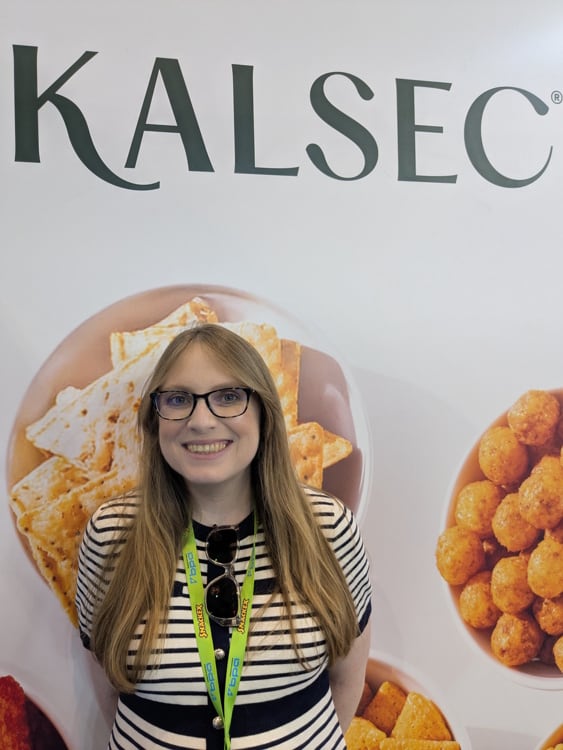
She expects ingredient lists to continue shrinking. “Maybe instead of 10 ingredients, it could be three or four ingredients in the future. We started off with a really natural product, then we added a lot of additional additives, and now we’re going backwards.”
Colour stability is only one part of that equation and preserving a natural colour also means preserving product quality. To make the point, Cuddihy showed me two paprika-coated snack samples. Both had started with the same colour and while one remained bright, the other had noticeably faded. She then opened the jars and the faded sample smelled unmistakably stale. “This is caused by lipid oxidation. The loss in colour is actually associated with the rancidity and off-flavours. You don’t just have the colour loss. You actually have the flavour.”
The demonstration showed why colour scientists increasingly talk about oxidation rather than appearance. Fading wasn’t simply a visual issue; it signalled flavour deterioration, rancidity and shortening shelf life.
Kalsec’s work combines natural colours with antioxidant systems, including rosemary extracts, to help protect pigments and extend shelf life. Cuddihy says antioxidant support can help improve stability through processing conditions such as baking and extrusion.
“It can help you with the heat stability,” she says. “It can help give it a light stability of the products.”
Red carries unusual commercial importance. Consumers instinctively associate it with sweetness, ripeness, spice and indulgence, making it one of the most widely used colours across confectionery, beverages, bakery, dairy and savoury snacks. That commercial value also explains why creating a stable, plant-based red remains one of food science’s toughest challenges.
Success extends well beyond colour chemistry. Processing conditions, product formulation, antioxidant systems, packaging design and shelf-life expectations all influence whether a product still looks – and tastes – the way manufacturers intended months after production.
Developing the right shade is only the beginning. Keeping it there may prove the industry’s greatest achievement.
Studies:
Khoo HE, Azlan A, Tang ST, Lim SM. Anthocyanidins and anthocyanins: colored pigments as food, pharmaceutical ingredients, and the potential health benefits. Food Nutr Res. 2017 Aug 13;61(1):1361779. HTTPS://doi:10.1080/16546628.2017.1361779. PMID: 28970777; PMCID: PMC5613902.
Herbach, K.M., Stintzing, F.C. and Carle, R. (2006), Betalain Stability and Degradation—Structural and Chromatic Aspects. Journal of Food Science, 71: R41-R50. https://doi.org/10.1111/j.1750-3841.2006.00022.x
Cao, Y., Song, H. and Chen, F. (2026), Bioactivity, stability, and bioavailability of betacyanins: progressing their utilization in the food industry. J Sci Food Agric, 106: 5705-5717. https://doi.org/10.1002/jsfa.70448
McCann D, Barrett A, Cooper A, Crumpler D, Dalen L, Grimshaw K, Kitchin E, Lok K, Porteous L, Prince E, Sonuga-Barke E, Warner JO, Stevenson J. Food additives and hyperactive behaviour in 3-year-old and 8/9-year-old children in the community: a randomised, double-blinded, placebo-controlled trial. Lancet. 2007 Nov 3;370(9598):1560-7. http://doi:10.1016/S0140-6736(07)61306-3. Erratum in: Lancet. 2007 Nov 3;370(9598):1542. PMID: 17825405.
Takebayashi-Caballero, N., Regalado-González, C., Amaro Reyes, A., Amaya-Llano, S. L., Granados-Arvizu, J. Á., Padrón, G. H., Castaño-Meneses, V., & Escamilla-García, M. (2026). Smart Packaging System with Betalains and Rosemary Essential Oil to Extend Food Shelf Life and Monitor Quality During Storage. Polysaccharides, 7(1), 5. https://doi.org/10.3390/polysaccharides7010005